Showing posts with label A Royal Likeness. Show all posts

Thursday, August 25, 2011

Cover Alert: "By the King's Design" by Christine Trent

Christine Trent author of By the King's Design, coming January 31, 2012. Available for pre-sale at your favorite online bookstore. Titles on sale now: The Queen's Dollmaker, A Royal Likeness
Like Christine's novels? Check out her Facebook page: Christine Trent on Facebook  
 
"Strong-willed Annabelle Stirling is more than capable of running the family draper shop after the untimely death of her parents. Under her father's tutelage, she became a talented cloth merchant, while her brother Wesley, the true heir, was busy philandering about Yorkshire. Knowing she must change with the times to survive, Belle installs new machinery that finishes twice the fabric in half the time it takes by hand. But not everyone is so enthusiastic.

Soon, riled up by Belle's competitors, the outmoded workers seek violent revenge. Her shop destroyed, Belle travels to London to seek redress from Parliament. While there, the Prince Regent, future King George IV, commissions her to provide fabrics for his Royal Pavilion. As Belle's renown spreads, she meets handsome cabinetmaker Putnam Boyce, but worries that marriage will mean sacrificing her now flourishing shop. And after Wesley plots to kidnap the newly-crowned King-whose indiscretions are surfacing-she finds herself entangled in a duplicitous world of shifting allegiances.

Painting a vivid portrait of life in the British Regency, Christine Trent spins a harrowing tale of ambition, vengeance, love, and complex loyalties against the dynamic backdrop of the early Industrial Revolution".

Amazon
The Queen's Dollmaker
A Royal Likeness
By the King's Design
~Lizzy~

Tuesday, December 28, 2010

In Stores Today: A Royal Likeness by Christine Trent

"As heiress to the famous Laurent Fashion Dolls business, Marguerite Ashby's future seems secure. But France still seethes with violence in the wake of the Revolution. And when Marguerite's husband is killed during a riot, the young widow travels to Edinburgh and becomes apprentice to her old friend, Marie Tussaud, who has established a wax exhibition. When Prime Minister William Pitt commissions a wax figure of Admiral Nelson, Marguerite becomes immersed in a dangerous adventure - and earns the admiration of two very different men. And as Britain battles to overthrow Napoleon, Marguerite will find her loyalties under fire from all sides. With a masterful eye for details, Christine Trent brings one of history's most fascinating eras to life in of a story of desire, ambition, treachery, and courage".
 
For More on Christine Trent:
Subscribe to her newsletter
footer sig

Tuesday, December 14, 2010

HFBRT Christine Trent "A Royal Likeness" wrap up

It is time to wrap it up and check out what went down for the Christine Trent "A Royal Likeness" HFBRT event.

Here is a list of my event posts just in case you did not catch them the first time:


For more on Christine Trent:

Giveaway Winner

The lucky winner of the final brand new copy of "A Royal Likeness" is...

Rosanne

For more on this event check out the group site and schedule at Historical Fiction Bloggers Round Table site.

Giveaways still going on for "A Royal Likeness"

Upcoming Giveaways from:

For More on Christine Trent:

Amazon
A Royal LikenessThe Queen's Dollmaker
footer sig

Friday, December 10, 2010

HFBRT: A ROYAL LIKENESS Guest Post with Christine Trent, Phantasmagoria!

Dust off the red carpet because here she comes! Christine Trent that is, the Historical Fiction Bloggers Round Table is pleased to feature the upcoming release of "A Royal Likeness" which will hit bookstores December 28th 2010. To coincide with the event Christine has graciously prepared a marvelous guest post on one very interesting show that was at one point linked to Madame Tussuad's wax exhibit, The Phantasmagoria. Please give a very warm welcome to Christine from Historically Obsessed and here we go!

 
Phantasmagoria! 
A ROYAL LIKENESS Guest Post with Christine Trent

It’s an exciting word, isn’t it? Sounds like a Disney movie.

In A Royal Likeness, I detail the relationship between Madame Tussaud and Paul de Philipsthal, a fellow French showman who persuaded her to travel to Great Britain with him to improve both their fortunes. 


Tussaud owned a fairly successful wax exhibition in Paris.  However, changing tastes in post-Revolutionary France meant that the show began waning in public popularity.  An opportunity presented itself in one Paul de Philipsthal, who had just returned from a successful run in London with his Phantasmagoria show.  He suggested that they combine her wax exhibition with his own show and put them both on display in England.  Together, he promised, they’d get very wealthy by providing unusual entertainments to the English.  

The relationship between these two would quickly sour, as Philipsthal was a bit of a charlatan.  He convinced Tussaud to sign an extremely uneven contract with him, one in which he would take half of her profits until she could pay off the loan he gave her to get established in Great Britain.  In return, he would pay to have her figures shipped around, and would also pay for advertising of both shows.  Unfortunately, Philipsthal didn’t live up to his end of the bargain.  Tussaud was stuck with paying for everything, AND repaying her loan, AND giving Philipsthal half of her profits.


Tussaud suffered under a mountain of debt until a lawyer took interest in her situation and, ahem, had a little discussion with Philipsthal over his wayward tactics.  Philipsthal released Tussaud from her contract, and the two never spoke again.  Madame Tussaud continued on with her vastly successful waxworks, while Philipsthal faded from history.

But what in the world is a Phantasmagoria?


Phantasmagoria is a projection ghost show invented in the late 18th century.  It employed a type of “magic lantern” to project frightening images such as skeletons, demons, and ghosts onto walls, smoke, or semi-transparent screens, frequently using rear projection. The projector was mobile, allowing the projected image to move and change size on the screen as the projector was moved around.  The use of multiple projecting devices allowed for quick switching of different images.

The magic lantern device, developed in the early 17th century, consisted of a lantern with a candle and concave mirror inside. A tube was fitted into the side of the lantern and held convex lenses at either end. Near the center of the tube, a glass slide of the image to be projected was held. Images were hand painted onto the glass slide until the mid-19th century, when photographic slides were employed. Unsurprisingly, the magic lantern was the precursor of both the slide projector and the motion picture projector. Though the magic lantern was often used for amusement by projecting quaint and pastoral imagery, projections were also made of phantoms, devils, and other macabre objects, thus giving rise to Phantasmagoria.

Although there were other Phantasmagoria-type shows in existence, Philipsthal’s was different in that he did not attempt to fool the audience members into believing that the apparitions were real.  In an opening speech, Philipsthal would make it clear that the phantasmagoric images were purely for entertainment. His honesty in this is ironic, given his faithless treatment of Madame Tussaud!

Although I gave Philipsthal a very different ending in my book (no spoilers here), in reality, he appears to have continued on his own for at least another twenty years, but history only remembers his partner, the great Madame Tussaud.

So, whatever happened to the concept of the Phantasmagoria?

For all of you devoted readers, a collection of poems written by Alice in Wonderland author, Lewis Carroll, called “Phantasmagoria,” was published in 1869. The main poem, which bears the collection’s title, is written as a narrative conversation between a phantom and a man who discuss the differences between ghosts and humans.

The influences of Phantasmagoria can still be seen in modern-day theme park attractions; most notably, those created by Walt Disney. The Disneyland Haunted Mansion, for example, employs “smoke and mirrors” in creating its ghostly special effects.

Want to read an interesting historical novel about magic lanterns?  Find a copy of Rosalind Laker’s BRILLIANCE, a historical romance that details how magic lanterns were the forerunner to the film-making industry.  After you’ve read A Royal Likeness, of course.
 
An 18th century Phantasmagoria

An advertisement for Philipsthal’s Phantasmagoria at the Lyceum Theatre, the first location in London for his joint show with Madame Tussaud.

I have no idea what this creature is supposed to be, but have no doubt it was very frightening to audiences!

Often the projector was behind a translucent screen, out of the view of the audience. This greatly added to the mystery of the show.

Thank you Christine for the interesting history on the Phantasmagoria. It is interesting to see how far the entertainment business has come from using lanterns and smoke screens. I bet it was a real spooky show in its hay day and the added pictures are great! Thank you so much for sharing with us all.

Check out the groups main page for more info and the schedule of events

Review of "The Queens Dollmaker"
Amazon 

Wednesday, December 08, 2010

HFBRT Christine Trent A ROYAL LIKENESS Event: Death Masks of Europe

!WARNING THIS POST DOES CONTAIN MATERIAL THAT IS GRAPHIC. DISCRETION IS ADVISED!

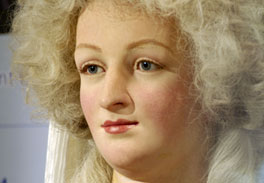
Since HFBRT is rolling out the red carpet for Christine Trent I figured it was about dang time for a good creative post. Plus the story inspired me to do some research of my own to see some of these mentioned death masks that were made by Madame Tussaud. The subject can be a bit disturbing but I think it is morbidly interesting. I mean really who would have known Napoleon's nose was so big, it did not show like that in the paintings. Even with that nose I still think that he was a very handsome man. In the up coming new release of "A Royal Likeness" Trent covers the later years of Madame Tussuad's life in England which does not include anymore death masks with the novels main character Marguerite. The picture above is the current Marie Antoinette at Madame Tussaud's exhibit in London.

"Tussaud was employed to make death masks of the victims of the guillotine. When the mob stormed the Bastille, Madame Tussaud was forced to make death masks of the revolutions most infamous dead such as Louis XVI, Marie Antoinette, Marat, and Robespierre. Her death masks were held up as revolutionary flags and paraded through the streets of Paris. Soon, Madame Tussaud was searching through sanitaries collecting the most illustrious heads she could find".

"In Western cultures a death mask is a wax or plaster cast made of a person’s face following death. Death masks may be mementos of the dead, or be used for creation of portraits. It is sometimes possible to identify portraits that have been painted from death masks, because of the characteristic slight distortions of the features caused by the weight of the plaster during the making of the mold. In other cultures a death mask may be a clay or other artifact placed on the face of the deceased before burial rites. The best known of these are the masks used by ancient Egyptians as part of the mummification process, such as Tutankhamon’s burial mask".


Creepy but one good thing that has come out of these masks is that one death mask known as L'Inconnue de la Seine which was taken in late 1880s in Paris of a unidentified woman who was found to have drowned in the Seine River. The masks original purpose was to serve like a Jane Doe picture in helping the relatives of the deceased recognize them if they were seeking a missing person. Many people found L'Inconnue de la Seine so beautiful that it became the fashion to have a mask of her in ones home. Her mask has been in use even today it has helped give a face to "the the world’s first CPR training mannequin, introduced in 1960, was modeled after L'Inconnue de la Seine" her name is Rescue Anne.
L'Inconnue de la Seine and Rescue Anne

!Readers Beware below is not meant for the faint of heart! 
Vice Admiral Lord Nelson life Mask. 
"Gentlemen, when the enemy is committed to a mistake we must not interrupt him too soon".
"I have only one eye, I have a right to be blind sometimes... I really do not see the signal"!

Death masks of Louis XVI on the far left with Robespierre next to him and Marie Antoinette on the far right.

Henry VII, death mask.

Henry VIII as a child, said to be made from a life mask but not confirmed to be him. 
"We are, by the sufferance of God, King of England; and the Kings of England in times past never had any superior but God." 

Death mask of Charles XII, King of Sweden. 
"Why then are you sad? God and I are still alive".

Mozart's death mask. 
“To talk well and eloquently is a very great art, but that an equally great one is to know the right moment to stop.”
“Neither a lofty degree of intelligence nor imagination nor both together go to the making of genius. Love, love, love, that is the soul of genius.” 

Beethoven's life mask.
"Art! Who comprehends her? With whom can one consult concerning this great goddess"? 
"What you are, you are by accident of birth; what I am, I am by myself. There are and will be a thousand princes; there is only one Beethoven". 


Mary Queen of Scots. 
"In my end is my beginning". 


Napoleon's death mask that was taken at St. Helena. 
"It is the cause, not the death, that makes the martyr". 
"In politics stupidity is not a handicap". 
"A throne is only a bench covered with velvet". 
"A leader is a dealer in hope". 


Death Mask by Madame Tussuad of Marie Antoinette.
“I was a queen, and you took away my crown; a wife, and you killed my husband; a mother, and you deprived me of my children. My blood alone remains: take it, but do not make me suffer long.” 

Death mask and gloves of Martin Luther. 
"I am more afraid of my own heart than of the pope and all his cardinals. I have within me the great pope, Self". 
"I have held many things in my hands, and I have lost them all; but whatever I have placed in God's hands, that I still possess". 
"When schools flourish, all flourishes". 
"You are not only responsible for what you say, but also for what you do not say".

Making a death mask.
Main Page, Schedule of Events
Check out my review of "The Queens Dollmaker"
Hitting bookstores everywhere December 28th 2010

"As heiress to the famous Laurent Fashion Dolls business, Marguerite Ashby's future seems secure. But France still seethes with violence in the wake of the Revolution. And when Marguerite's husband is killed during a riot, the young widow travels to Edinburgh and becomes apprentice to her old friend, Marie Tussaud, who has established a wax exhibition. When Prime Minister William Pitt commissions a wax figure of Admiral Nelson, Marguerite becomes immersed in a dangerous adventure - and earns the admiration of two very different men. And as Britain battles to overthrow Napoleon, Marguerite will find her loyalties under fire from all sides. With a masterful eye for details, Christine Trent brings one of history's most fascinating eras to life in of a story of desire, ambition, treachery, and courage".

For More on Christine Trent:
Christine's Website
Subscribe to her newsletter

Amazon
The Queen's DollmakerA Royal Likeness
~Lizzie~